
By R Bsri , Staff Reporter
28 August 2026
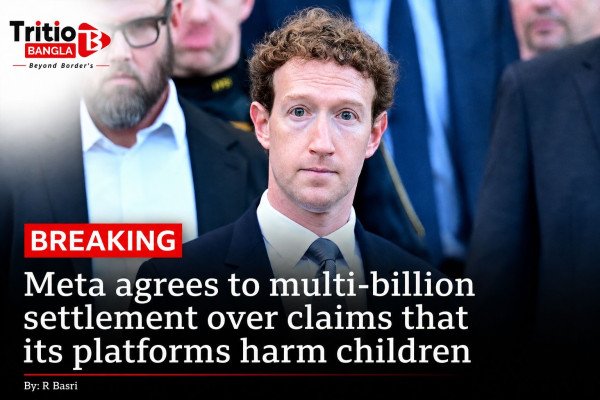
Meta Platforms, the parent company of Facebook and Instagram, has agreed to a landmark multibillion-dollar settlement with US state attorneys general over allegations that its social media platforms were deliberately designed in ways that could harm children and teenagers.
The agreement, announced on Wednesday, brings an end to a closely watched legal battle in which authorities accused Meta of using addictive features to keep young users engaged, misleading the public about the safety of its platforms and improperly collecting personal information from children.
Reuters reported that court documents put the settlement at up to $16.68 billion, while Meta described the broader agreement as involving approximately $18 billion in payments over a 10-year period. The final value depends partly on conditions involving other major social media platforms. (Reuters)
The case involved a broad coalition of US attorneys general. Meta said its agreement was reached with a bipartisan group of 52 attorneys general representing states, US territories and the District of Columbia. The agreement is being presented as one of the largest state consumer-protection settlements involving a technology company. (About Facebook)
Major changes to Facebook and Instagram
As part of the agreement, Meta will introduce significant new restrictions for users under 18 in participating US states and territories, subject to judicial approval.
One of the most significant measures is a default two-hour daily limit on Facebook and Instagram. Teenagers will not be able to remove the restriction without parental permission, and time spent across both platforms will count towards the combined limit.
Meta will also introduce a default Night Mode, blocking access to key parts of Facebook and Instagram between midnight and 6am. Notifications will also be muted during school hours, generally between 8am and 3pm, although direct messages and certain safety-related alerts will remain available. (About Facebook)
Teenagers will receive reminders after every 15 minutes of continuous screen time, as well as prompts when they reach 60 and 90 minutes of daily use.
Other measures include stronger parental supervision tools, improved age-assurance technology, greater restrictions on age-inappropriate content, the ability for teenagers to use a non-algorithmic feed and controls allowing them to disable autoplay.
Meta also agreed to restrict certain cosmetic surgery and extreme makeup filters for teenage users and strengthen protections against unwanted contact from suspicious adults. (About Facebook)
Allegations of addiction and mental-health harm
The legal action was part of a much wider US campaign against major social media companies over alleged effects on young people’s wellbeing.
State authorities accused Meta of designing features that encouraged excessive and potentially addictive use while failing to adequately protect children from harmful content and interactions.
The allegations became particularly significant during the federal trial in California, where evidence included testimony from former Meta safety engineer Arturo Béjar. He alleged that Meta had been warned about problems affecting young users and that the company placed insufficient priority on child safety. Meta rejected the allegations and maintained that it has invested heavily in safety measures for teenagers. (The Guardian)
The settlement avoids a potentially lengthy trial that could have placed Meta CEO Mark Zuckerberg in the witness box. The agreement therefore represents a major legal and financial development for the technology giant.
Meta denies wrongdoing
Despite agreeing to the settlement, Meta has not admitted wrongdoing.
The company said the agreement builds on measures it had already introduced to give parents greater control over their children’s use of its services. Meta said it wanted to establish a new standard for protecting teenagers online and called on rival platforms, including TikTok and YouTube, to introduce comparable safeguards. (About Facebook)
Meta’s agreement also establishes independent oversight and research arrangements. An independent auditor will assess the company’s compliance with the settlement, while a research foundation will be created to support independent research into social media and teenage wellbeing. Most of the agreement’s provisions are expected to remain in place for several years. (About Facebook)
A landmark moment for Big Tech
The settlement is being viewed as a significant moment in the growing legal and political debate over the responsibilities of social media companies towards children.
For years, governments, parents, schools and child-safety campaigners have raised concerns about excessive screen time, addictive platform design, harmful content, online bullying, privacy and the wider impact of social media on young people’s wellbeing.
The Meta settlement does not end those debates. Numerous other lawsuits involving Meta and other technology companies remain active.
However, the agreement could have consequences well beyond Facebook and Instagram. If similar safeguards are adopted across the wider social media industry, the settlement could mark a major shift in how technology companies design, market and regulate services used by children and teenagers.
For parents, the immediate significance is clear: if the agreement receives the required judicial approval, teenagers using Facebook and Instagram in participating US jurisdictions will face stronger restrictions, while parents will gain substantially greater control over how their children use the platforms.
The settlement therefore represents not only a huge financial agreement, but also a potentially important turning point in the long-running effort to make social media safer for young people.
 আইটি ল্যাব সলিউশন্স লি.