

প্রকাশ: ১২ আগস্ট ২০২৬ ২২:১৭
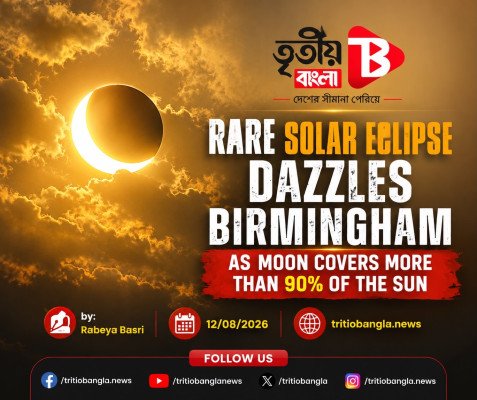
Rabeya Basri : Birmingham, 12 August 2026: A spectacular partial solar eclipse is captivating skywatchers across Birmingham and communities throughout the UK today, as the Moon passes between the Earth and the Sun in one of the most anticipated astronomical events of the year.
The eclipse is visible across the United Kingdom, with Birmingham experiencing a particularly deep partial eclipse. Astronomical data shows that the eclipse began in Birmingham at approximately 6:15pm BST, reached its maximum at around 7:11pm, and is expected to end at approximately 8:05pm. At its peak, around 91.8 per cent of the Sun will be obscured by the Moon. (Sky at Night Magazine)
The event is part of a total solar eclipse, with the path of totality passing through parts of Greenland, Iceland and northern Spain. However, the UK lies outside that narrow path, meaning observers in Birmingham and elsewhere in Britain are witnessing a deep partial eclipse rather than totality. (Royal Museums Greenwich)
The rare spectacle has generated considerable excitement among families, astronomy enthusiasts, photographers and members of the public, many of whom have been preparing to watch the changing shape of the Sun as the Moon gradually moves across its face.
For Birmingham residents, the timing of the event provides an opportunity to witness an unusually dramatic eclipse from the city. Across the UK and Ireland, between approximately 90 and 96 per cent of the Sun is being covered, depending on location. (Royal Museums Greenwich)
A rare astronomical opportunity
Solar eclipses occur when the Moon moves between the Earth and the Sun, temporarily blocking sunlight from reaching parts of the Earth’s surface. Although solar eclipses happen somewhere on Earth relatively regularly, seeing a deep eclipse from a particular location is considerably less common.
Today’s event is particularly significant because the next total solar eclipse visible from the UK is not expected until 23 September 2090, meaning the wait for totality over Britain will extend for decades. The 2026 event is therefore being regarded as an exceptional opportunity for people across the country to experience a major celestial event. (The Guardian)
The eclipse also comes at a time when public interest in astronomy and space science continues to grow, with schools, families, photographers and astronomy groups using the event as an opportunity to learn more about the relationship between the Earth, Moon and Sun.
Safety warning issued
While the eclipse is a spectacular sight, experts are urging the public to take appropriate precautions.
The UK Health Security Agency has warned that looking directly at the Sun without suitable protection can cause permanent damage to eyesight. Members of the public are advised to use appropriate certified solar-viewing protection and never look directly at the Sun through ordinary sunglasses, cameras, binoculars or telescopes without the correct solar filters. (ukhsa.blog.gov.uk)
Eye specialists have also issued warnings ahead of the event, stressing that the partial phase can be particularly dangerous because the Sun remains extremely bright even when most of its disc is covered. (qvh.nhs.uk)
As evening approaches, Birmingham and the wider UK are witnessing a remarkable reminder of the scale and precision of our solar system.
For those able to view it safely, today’s eclipse offers a rare chance to look up from everyday life and witness a spectacular piece of the universe unfolding above the city.
News Of English থেকে আরো পড়ুন