
প্রকাশ: ১৩ অক্টোবর ২০২৬ ১২:৫৭
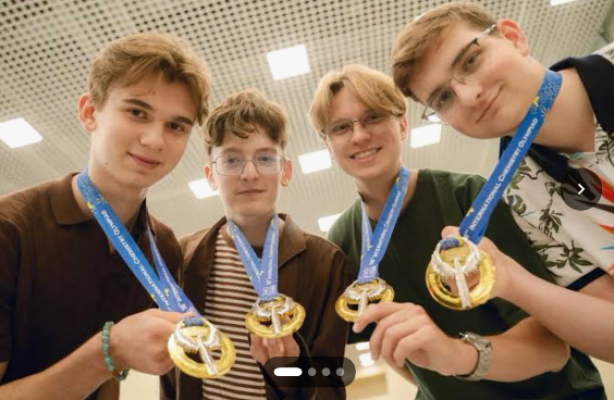
Staff Reporter: MOSCOW, 12 October 2026: Russian school students have won 91 medals at international academic Olympiads so far this year, including 64 gold, 26 silver and one bronze, according to figures announced by the Russian government. The results highlight the achievements of young students in mathematics, physics, chemistry, biology and other academic disciplines.
The interim results were announced by Deputy Prime Minister Dmitry Chernyshenko and Education Minister Sergey Kravtsov, who praised the students’ achievements and acknowledged the contribution of teachers, mentors and families in supporting their success. <Cite refs={[“turn460488search0”,“turn460488search2”]}/>
The announcement provides a snapshot of Russia’s performance in international subject competitions during 2026. Of the 91 medals, 31 were earned at competitions classified by the Russian authorities as major international academic Olympiads, regarded as particularly demanding intellectual contests. <Cite refs={[“turn460488search0”]}/>
A Strong Performance Across Academic Disciplines
The medals have been earned at a range of international competitions, including the 60th International Mendeleev Chemistry Olympiad, the Asian Physics Olympiad, the Open International Biology Olympiad, the Avicenna International Biology Olympiad and the Romanian Master of Mathematics.
These competitions challenge students to demonstrate advanced subject knowledge, analytical reasoning, problem-solving skills and the ability to apply classroom learning to complex questions.
Success at this level generally requires extensive preparation beyond the standard school curriculum. Students often work intensively with specialist teachers and mentors, practising difficult problems and developing the ability to perform under competitive conditions.
The reported results therefore reflect not only individual academic ability but also the preparation and support that help students compete internationally.
Gold Medals Lead the Results
The medal tally announced on 12 October comprises:
* 64 gold medals
* 26 silver medals
* 1 bronze medal
Together, the awards total 91 medals, with gold accounting for the largest share.
Russian officials reported that the country’s school teams had participated in six major and eight intermediate international academic competitions during 2026. The authorities said every participating student had returned with a medal in the competitions covered by the announcement. <Cite refs={[“turn460488search0”]}/>
One notable achievement came at the Open International Biology Olympiad in May, where the Russian delegation won 11 gold medals and one silver. The competition brought together school students from 17 countries and included teams representing different levels of academic achievement. <Cite refs={[“turn460488search3”]}/>
In physics, the Russian team also secured five gold medals and the Grand Prix at the International Scientific Physics Olympiad held in June. The event attracted 136 students from 30 countries, demonstrating the international reach of academic competition in the sciences. <Cite refs={[“turn460488search4”]}/>
Students from Across Russia Contribute
The teams represented a wide geographical area, with students drawn from Moscow, St Petersburg, Moscow Region, the Republic of Tatarstan, Novosibirsk, Volgograd, Samara, Chelyabinsk, Kaliningrad, Nizhny Novgorod and other Russian regions.
The breadth of representation suggests that the country’s academic talent is not limited to a single city or educational institution. Students from different regions have opportunities to demonstrate their abilities through national selection processes and subsequent participation in international contests. <Cite refs={[“turn460488search0”]}/>
Identifying talented students, providing specialist training and maintaining access to challenging academic opportunities are important elements of preparing young people for these competitions.
Teachers and mentors play a particularly significant role in helping students develop the confidence and technical skills required to tackle unfamiliar problems. Families also provide essential encouragement throughout what can be a demanding preparation process.
Education, Research and Future Opportunities
Academic Olympiads can help students develop skills that are valuable beyond the competition itself. Mathematics strengthens logical reasoning, while physics, chemistry and biology encourage scientific thinking, experimentation and evidence-based analysis.
Students who perform well may also gain opportunities to pursue further study, enter research programmes and develop careers in science, technology, engineering and other specialist fields.
For countries seeking to develop scientific expertise and technological capability, nurturing young talent is an important long-term investment. However, medals alone do not measure the overall quality of an education system. Broader indicators, including access to education, teaching standards, research opportunities and the ability to turn knowledge into practical innovation, also matter.
The Competition Season Continues
The Russian government has indicated that the 2026 academic Olympiad season is not yet over. The country’s school team is expected to participate in the 23rd International Junior Science Olympiad in December, providing another opportunity for young students to demonstrate their scientific knowledge and problem-solving abilities. <Cite refs={[“turn460488search0”]}/>
The latest figures mark a significant milestone for Russian school students in international academic competitions. Behind each medal lies a combination of preparation, determination, teaching and support.
As the remaining competitions approach, attention will turn to whether Russian students can add to their tally and maintain their strong reported performance across a range of academic disciplines.
Source: Russian Ministry of Education, announcement dated 12 October 2026; Interfax Russia, report dated 12 October 2026.
News in English থেকে আরো পড়ুন
এ সম্পর্কিত আরো পড়ুন