

প্রকাশ: ১৪ অক্টোবর ২০২৬ ১৩:০৯
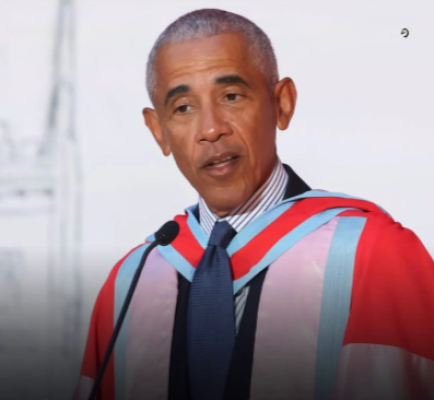
BELFAST, 13 October 2026: Former United States President Barack Obama has received an honorary doctorate from Queen’s University Belfast (QUB), using the occasion to praise Northern Ireland’s progress towards peace and urge the next generation to protect democracy, promote inclusion and build a better future for all.
At a special ceremony attended by university staff, students and invited guests, Obama reflected on the transformation of Northern Ireland since the Good Friday Agreement of 1998. His address highlighted the importance of reconciliation, education, equal opportunities and the responsibility of young people to sustain the progress achieved through decades of peacebuilding.
The former president described the Good Friday Agreement as a powerful example of what can be accomplished when communities move beyond historical divisions and choose peaceful coexistence.
“The Good Friday Agreement is still a shining example of what can happen when people put aside old wounds and choose peace,” Obama said.
However, he cautioned that peace and democracy should never be taken for granted. Referring to challenges in countries around the world, including his own, he emphasised that both require continuous commitment.
“But as we have seen in many countries, including in my home country the United States, peace and democracy are not inevitable. They have to be chosen, again and again,” he added.
His message carried particular significance in Northern Ireland, where the peace process has helped create opportunities for communities that experienced decades of political conflict and violence.
A Legacy of Peace and Reconciliation:
The Good Friday Agreement, signed in April 1998, marked a historic turning point in Northern Ireland. It established a framework for power-sharing, strengthened cooperation between communities and governments, and helped bring an end to much of the violence associated with the Troubles.
Although significant challenges remain, the agreement continues to serve as an internationally recognised example of political dialogue and reconciliation.
Obama’s remarks underlined the importance of preserving these achievements. Peace, he suggested, is not simply the absence of conflict. It also requires communities to recognise one another’s humanity, create opportunities for all citizens and remain committed to resolving differences through dialogue rather than hostility.
Reflecting on his earlier visit to Belfast in 2013, he acknowledged the progress made while recognising that younger generations continue to face considerable social and economic challenges.
His address encouraged Northern Ireland to build on its achievements by ensuring that the benefits of peace reach people from every background.
Young People at the Heart of Change:
A central theme of Obama’s address was the role of education and young people in shaping a more inclusive society.
During the ceremony, Emma McAllister, a first-year Law with Politics student from North Belfast, presented his honorary degree citation. McAllister had previously participated in R-CITY, a cross-community programme that connects young people from the Ardoyne and Shankill areas and supports their leadership development and access to educational opportunities.
Her journey illustrated how community programmes can help young people overcome barriers, develop confidence and pursue ambitions that may once have seemed beyond their reach.
Obama praised initiatives that bring young people together across traditional community divisions and encourage them to see higher education as an achievable goal.
“That’s what peace makes possible. And it’s what Queen’s and the supporters in this room are helping to make real,” he said.
The example reinforced his wider message that a person’s background should not determine their future. Education, mentorship and inclusive institutions can help create pathways to achievement while encouraging understanding between communities.
In his closing remarks, Obama challenged the university community to continue demonstrating what can be achieved through cooperation, ambition and inclusion.
“I want to use this opportunity as an honorary Queen’s graduate to leave you all with a challenge and that is to keep showing the way,” he said.
Queen’s University Recognises a Global Contribution :
Queen’s University Belfast welcomed Obama’s visit as an opportunity to recognise his contribution to public service and his longstanding emphasis on peace, dialogue and democratic values.
The university’s President and Vice-Chancellor, Professor Sir Ian Greer, congratulated the former president on receiving the institution’s highest honour.
“We are privileged to welcome President Obama to Queen’s. His commitment to peace, dialogue and public service has left a lasting impact around the world, and particularly here in Northern Ireland,” Professor Greer said.
Honorary degrees recognise individuals whose achievements or service have made a significant contribution to society. Obama’s award reflects the university’s recognition of his international public service and his association with the values of peace, leadership and civic responsibility.
A Wider Message of Hope :
Following the university ceremony, Obama was also scheduled to address an audience at Belfast’s O2 Arena in a public conversation hosted by writer and journalist Susan McKay. The discussion formed part of a speaking engagement that included stops in other UK cities.
His visit came at a time of continuing international uncertainty, making his message about peaceful coexistence and democratic responsibility particularly relevant.
The former president’s central argument was that lasting progress depends on people’s willingness to look beyond division, acknowledge differences and work towards shared goals. His remarks also served as a reminder that democratic institutions and peaceful societies depend on active participation rather than historical achievements alone.
For Northern Ireland, the message was both a recognition of progress and a challenge to continue the work of reconciliation. For students and young people, it was an encouragement to pursue education, challenge social barriers and contribute positively to their communities.
Obama’s honorary doctorate ceremony at Queen’s University Belfast therefore represented more than an academic distinction. It provided an opportunity to reflect on the achievements of the peace process and the continuing responsibility of individuals, institutions and political leaders to protect the conditions that make peaceful and inclusive societies possible.
His challenge to the Queen’s community to “keep showing the way” offered a fitting conclusion to a visit centred on hope, opportunity and the belief that a more peaceful future can be built through sustained effort.
Sources: Queen’s University Belfast, official announcement of the honorary doctorate, 13 October 2026; BBC News NI coverage; RTÉ News reporting, 14 October 2026.
News in English থেকে আরো পড়ুন
এ সম্পর্কিত আরো পড়ুন