

প্রকাশ: ১৫ অক্টোবর ২০২৬ ১৬:৫১
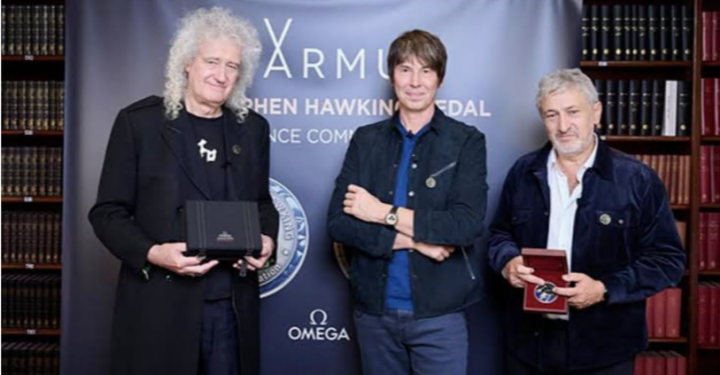
British physicist and television presenter Professor Brian Cox has been awarded the prestigious 2026 Stephen Hawking Medal for Science Communication in recognition of his outstanding contribution to making science accessible to millions of people around the world.
The award was presented to Professor Cox on 2 October at a private ceremony held at the Royal Astronomical Society in London. The medal was presented by STARMUS Festival co-founders Sir Brian May, the celebrated Queen guitarist and astrophysicist, and astrophysicist Garik Israelian. The occasion was filmed by ITV News and subsequently reported by the broadcaster. <Cite refs={[“turn362998search1”,“turn362998search3”]}/>
The recognition celebrates Professor Cox’s remarkable ability to explain complex scientific ideas in an engaging and accessible way, inspiring audiences to explore the mysteries of the universe and develop a deeper appreciation of scientific discovery.
Celebrating a decade of scientific inspiration
The Stephen Hawking Medal was established in 2016 by the late Professor Stephen Hawking and STARMUS to honour individuals whose work connects science with wider society through communication, literature, music, film and other creative disciplines.
The award reflects the belief that scientific knowledge should not remain confined to laboratories, universities and specialist academic circles. Instead, it should inspire curiosity, encourage critical thinking and help people understand the world around them.
The 2026 award is particularly meaningful for Professor Cox, who was present when the medal was first announced a decade ago.
Speaking after receiving the honour, he said: “It’s a great honour to receive the 2026 Stephen Hawking Medal from STARMUS, and particularly poignant for me because I was there with Stephen when the Medal was first announced 10 years ago.”
Reflecting on the importance of scientific exploration, he added that seeking to understand the universe was more important than ever in today’s divided world. He also recalled Stephen Hawking’s enduring encouragement to look towards the stars, describing the pursuit of knowledge as central to science and life. <Cite refs={[“turn362998search1”,“turn362998search3”]}/>
Bringing science closer to the public
Professor Cox has become one of Britain’s best-known science communicators through his work as a physicist, author, broadcaster and presenter of popular science programmes.
His television documentaries have introduced audiences to subjects including the origins of the universe, the nature of space and time, black holes and the fundamental laws governing the cosmos.
By combining scientific expertise with clear explanations and compelling visual storytelling, he has helped make challenging subjects more understandable to viewers of different ages and educational backgrounds.
His work demonstrates the importance of science communication in a world where scientific literacy, evidence-based reasoning and public understanding are increasingly significant.
The recognition also highlights the role of broadcasters, educators and researchers in encouraging young people to pursue careers in science, technology, engineering and mathematics.
Honouring Stephen Hawking’s legacy
The medal carries the name of Professor Stephen Hawking, one of the world’s most influential theoretical physicists, whose work transformed scientific understanding of black holes and the universe.
Despite living with motor neurone disease, Hawking continued his research and became an internationally recognised advocate for scientific discovery and public engagement.
He believed that the wonders of the universe should be accessible to everyone, regardless of their background. The medal established in his name continues that mission by recognising people who make science more engaging and meaningful to society.
Previous recipients have included renowned broadcaster Sir David Attenborough and filmmaker Christopher Nolan, reflecting the award’s broad recognition of individuals who connect scientific ideas with public audiences through different forms of communication and creativity. <Cite refs={[“turn362998search1”,“turn362998news7”]}/>
Following the ceremony, Professor Cox also received a special OMEGA Speedmaster Moonwatch crafted from 18-carat Moonshine™ Gold, presented as part of the recognition.
Science, music and art come together at STARMUS
The award forms part of the wider programme of STARMUS, an international festival bringing together leading scientists, astronauts, musicians, artists and thinkers to celebrate exploration, creativity and scientific discovery.
Founded by Garik Israelian and Sir Brian May, STARMUS promotes collaboration between science and the arts, encouraging audiences to consider humanity’s place in the universe.
The eighth edition, STARMUS VIII: The Search for Truth, is scheduled to take place in Tenerife and La Palma in Spain’s Canary Islands from 17 to 22 October 2026.
Professor Cox’s medal presentation in London is expected to feature in the festival’s opening celebration, allowing a wider audience to share in the recognition despite his touring commitments preventing him from attending the event in Tenerife. The programme brings together science, music and culture, underlining the festival’s commitment to making scientific discovery an inspiring public experience. <Cite refs={[“turn362998search1”,“turn362998search4”]}/>
Inspiring the next generation
Professor Cox’s achievement is more than an individual professional honour. It recognises the wider importance of communicating scientific knowledge in ways that encourage curiosity, challenge misconceptions and inspire future generations.
At a time when misinformation can spread rapidly, the ability to explain scientific evidence clearly is essential to informed public debate and decision-making.
By bringing the universe into classrooms, living rooms and public conversations, science communicators help people appreciate both the achievements and the unanswered questions of modern science.
The 2026 Stephen Hawking Medal therefore celebrates not only Professor Cox’s contribution to broadcasting and public education, but also the enduring principle associated with Hawking’s legacy: that the search for knowledge belongs to everyone.
As STARMUS marks a decade of the medal, Professor Cox’s recognition serves as a powerful reminder that science can unite people through curiosity, imagination and a shared desire to understand the universe.
Sources: STARMUS Foundation; Royal Astronomical Society ceremony coverage; ITV News; Euronews
আন্তর্জাতিক থেকে আরো পড়ুন
এ সম্পর্কিত আরো পড়ুন