

প্রকাশ: ১৭ অক্টোবর ২০২৬ ১১:২৬
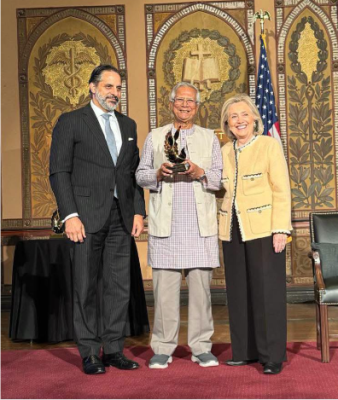
Nobel Peace Prize laureate Professor Muhammad Yunus has received the prestigious Hillary Rodham Clinton Award at Georgetown University in recognition of his pioneering work in poverty alleviation, microfinance, women’s economic empowerment and social business.
Former US Secretary of State Hillary Rodham Clinton presented the award to Professor Yunus during a ceremony at the university’s historic Gaston Hall on Thursday, 15 October. The event brought together approximately 400 guests, including ambassadors from nearly 25 countries, entrepreneurs, academics and researchers.
Professor Yunus, founder of Grameen Bank, was among three recipients of the Hillary Rodham Clinton Award this year. The other recipients were Reema Nanavaty, director of India’s Self-Employed Women’s Association (SEWA), and Tory Burch, fashion designer and founder of the Tory Burch Foundation. Muna Sukhtian, board chair of Jordan’s Microfund for Women, received the Georgetown Ambassadors Award.
The ceremony, organised by Georgetown University’s Institute for Women, Peace and Security, highlighted the importance of women’s economic opportunity, leadership and participation in building more peaceful, secure and prosperous societies.
Clinton Praises Yunus’s Contribution to Women’s Empowerment :
Presenting the award, Hillary Rodham Clinton praised Professor Yunus’s longstanding commitment to helping women achieve financial independence and greater control over their lives.
Clinton said she had personally witnessed the work of Grameen Bank and the impact of its approach in enabling women to become more self-reliant, financially secure and empowered. She also recognised how the initiative had extended beyond Bangladesh to influence communities internationally.
The recognition reflects the wider significance of Yunus’s work in challenging conventional approaches to poverty. Rather than viewing people living in poverty simply as recipients of assistance, his microfinance model sought to give them access to financial resources and opportunities to build sustainable livelihoods.
Grameen Bank became internationally known for providing small loans, particularly to women who were often excluded from traditional banking services. The approach helped bring financial inclusion and women’s economic participation into international discussions about development.
Five Decades of Work Against Poverty :
In his acceptance remarks, Professor Yunus reflected on approximately 50 years of work focused on reducing poverty and creating opportunities for disadvantaged communities.
He emphasised that microcredit was developed to help people living in extreme poverty stand on their own feet. Women were central to this approach because access to finance could help them strengthen their livelihoods, make economic decisions and improve their families’ circumstances.
Yunus also highlighted the changing position of women associated with Grameen Bank, describing their growing confidence, independence and involvement in managing their financial affairs. He noted that Grameen Bank’s borrowers are its owners, underlining the institution’s distinctive ownership structure.
For Yunus, however, the fight against poverty extends beyond access to loans. He has increasingly promoted social business as a way of addressing pressing social problems through sustainable enterprises.
Under this approach, businesses are designed primarily to solve human and social challenges rather than maximise personal profit. Surpluses can be reinvested to expand services and increase social impact, including in healthcare and other essential areas.
Social Business and a New Vision for Education :
Professor Yunus also outlined his vision of encouraging young people to become entrepreneurs rather than depend solely on traditional employment.
He argued that education should do more than prepare students to seek jobs. It should nurture creativity, initiative and the ability to develop solutions to real-world problems. His message was that young people should be encouraged to create employment opportunities for themselves and others.
As part of this vision, Yunus discussed plans for Grameen University, which he hopes will help advance entrepreneurship and social business. He linked this ambition to his broader concept of a “World of Three Zeros”: zero poverty, zero unemployment and zero net carbon.
The vision reflects his belief that economic development should be measured not only by financial growth but also by its contribution to human welfare, environmental sustainability and equal opportunity.
Honouring Global Leadership :
The other award recipients also represent different approaches to advancing women’s economic participation.
Reema Nanavaty leads SEWA, an organisation supporting women in the informal economy in India. Tory Burch established her foundation to support women’s economic empowerment, particularly through entrepreneurship. Muna Sukhtian, recognised with the Georgetown Ambassadors Award, leads the board of Jordan’s Microfund for Women, which works to expand financial opportunities for women.
Together, the honourees represent efforts across different countries and sectors to address economic barriers and strengthen women’s opportunities to participate in society.
The ceremony placed particular emphasis on the relationship between economic empowerment and peace and security. When women have greater access to resources, education and opportunities to earn a living, they can play a stronger role in their families & communities.
A Global Recognition for Bangladesh :
Professor Yunus’s recognition at Georgetown University is a significant moment for Bangladesh, whose development experience has helped shape international debates on microfinance, social entrepreneurship and poverty reduction.
His work has attracted international attention for decades, particularly following his joint receipt of the 2006 Nobel Peace Prize with Grameen Bank for their efforts to create economic and social development from below. The award recognised the role of microcredit in expanding economic opportunities for people who had limited access to conventional financial services.
The Hillary Rodham Clinton Award adds to the international recognition of Yunus’s contribution and brings renewed attention to the continuing challenges of poverty, financial exclusion and gender inequality.
As discussions about economic opportunity and sustainable development continue worldwide, the ceremony served as a reminder that lasting progress requires more than financial resources alone. It also depends on inclusive institutions, innovative ideas and opportunities for people to shape their own futures.
For Professor Yunus, the central objective remains clear: to build an economy that serves people and addresses human needs. His recognition at Georgetown University places that ambition firmly within the international conversation about women’s empowerment, entrepreneurship and a more equitable future.
The award is not only a recognition of past achievements but also an opportunity to renew the global commitment to a world where poverty is reduced, women can participate fully in economic life, and young people are equipped to become creators of opportunity.
Sources: Georgetown University’s Institute for Women, Peace and Security; Bangladesh Sangbad Sangstha (BSS); The Business Standard.
News in English থেকে আরো পড়ুন
এ সম্পর্কিত আরো পড়ুন